Tuesday, June 4, 2019

Record Setting May Weather


Denver Weather Breaking Records 


It's official May went down as the 7th coldest May in 147 years and the wettest May in two years. The average temperature was 51.6 degrees. The normal average May temperature is usually around 57 degrees.  With this cold weather all plant life was slow to come out of winter, from trees, turf and agricultural crops like corn.  Normally corn should be ankle high by now but the corn has just germinated over the last week.  We are hoping for a warmer June but that may be unlikely because of a persistent  El Nino this year.

In addition our new tee and approach mowers arrived yesterday and the lake aeration equipment is on the way.   With the warmer weather we have had lately the turf is taking off finally and the flower pots  will be planted next week. 

Over the next few weeks we will be continuing our normal maintenance programs including spray weeds and our bulk organic fertilizer app will be applied.  45 yards of mulch was ordered and arrived yesterday we will start chipping away at that project around the club beds.

The entire Agronomy team is excited that summer is finally here!

Monday, June 11, 2018

Summer Heat Stress and Localized Dry Spot


This is a great educational video on some of the heat stress that we have been dealing with on the golf course over the last week. This turf stress was brought on by record high temperatures and high winds over  the last week as well as no measurable  rain in 22 days. I hope this educates our members on the problems of turf heat stress and the actions we take on a daily basis in the summer. 


Localized dry spot or (LDS) are found on all types of turf grasses and soil conditions all over the world. These LDS areas are characterized by non-wettable or hydrophobic soil conditions. These areas usually have excessive organic mater and a waxy fungus in the soil medium called mycelium. Controlling localized dry spots is an ongoing and some times difficult battle, especially if you let the areas severely dry out. If localized dry spot is present it is best to spike areas, apply a wetting agent and immediately water in . The wetting agent helps breaks up the waxy build up and allows the soil to take the water. Other practices to minimize the severity of localized dry spots include thatch removal, application of a fungicide or core aerification.

Wednesday, October 14, 2015

Audubon Recertification

Exciting news we just received our Audubon recertification earlier this month. Below is a press release

The Pinery Country Club Recognized for Environmental Excellence

PARKER, CO – The Pinery Country Club has retained its designation as a "Certified Audubon Cooperative Sanctuary” through the Audubon Cooperative Sanctuary Program for Golf Courses, an Audubon International program.
Participation is designed to help course personnel plan, organize, implement, and document a comprehensive environmental management program and receive recognition for their efforts. To reach certification, a course must demonstrate that they are maintaining a high degree of environmental quality in a number of areas including: Environmental Planning, Wildlife & Habitat Management, Outreach and Education, Chemical Use Reduction and Safety, Water Conservation, and Water Quality Management.
"The Pinery Country Club has shown a strong commitment to its environmental program. They are to be commended for their efforts to provide a sanctuary for wildlife on the golf course property," said Tara Pepperman, Director of Cooperative Sanctuary Programs at Audubon International.
The Pinery Country Club is one of 47 courses in Colorado and 913 courses in the world to hold the honor. Golf courses from the United States, Africa, Australia, Central America, Europe, South America, and Southeast Asia have also achieved certification in the program. The golf course was designated as a Certified Audubon Cooperative Sanctuary in 2012. After designation, courses go through a recertification process every three years.
This year the recertification process, coordinated by Steve Whiting, Superintendent, required a visit by a local community representative. Dan Hamman, Water Superintendent at Pinery Water, was given a tour of the course and sent his observations to Audubon International. “It’s great to know that we have a partner in serving our community and conservation of our greatest resource and protecting our environment,” Hamman reported.
“We see the site visit as an important component of a course’s recertification,” stated Pepperman. “It provides an objective verification of some of the more visible aspects of the course’s environmental management activities. In addition, it offers an opportunity for golf course representatives to share publicly some of the voluntary actions they have taken to protect and sustain the land, water, wildlife, and natural resources around them.” Of Pinery Country Club’s involvement with the program, Whiting wrote: “It has been an honor to represent the Audubon Cooperative Sanctuary at the Pinery Country Club. I look forward to continuing to make a beneficial environmental impact in Colorado and around the world.

About Audubon International
Audubon International is a not-for-profit 501(c)(3) environmental education organization dedicated to providing people with the education and assistance they need to practice responsible management of land, water, wildlife, and other natural resources. To meet this mission, the organization provides training, services, and a set of award-winning environmental education and certification programs for individuals, organizations, properties, new developments, and entire communities.
For more information, contact Audubon International at 120 Defreest Drive, Troy, NY 12180, (518) 767-9051, e-mail at acsp@auduboninternational.org, or visit the website at www.auduboninternational.org.


Thursday, June 11, 2015

Butterfly Habitat

Another great area for butterfly's hole 13 in a area we seed with our custom wildflower mixture. Some great flowers this year because of all the rain. 

Wednesday, June 10, 2015

2015 Golf Operations Team

The Pinery's 2015 Golf Operations Team 

Saturday, May 23, 2015

Busy as a Bee

 Honey bees almost have the entire first box full of comb. It has been two weeks since they arrived. I hope to add the next box later in the week. 

Wednesday, May 13, 2015

Mothers Day Freeze


A great link to Swingle  about to potential damage to our tree's and shrubs this mothers day.

Mothers Day Freeze

Monday, May 4, 2015

Arrival of the Bees !

Our Italian Honey bees and Queen arrived today for the Pinery Pollinators. 
We had a successful bee release into the new hive on Saturday evening. Below are some pictures of the event.  Keep checking the blog for some video. 


Signs mark the area where the hive is placed. 
East of #3 mountain and west of  #4 mountain green 


A 3 pound box of bees with Queen . About 10,000  honey bees!  
From Apis Hives in Grand Junction
Italian Honey bees are bred for there calm demeanor


Inserting  the bees in the hive.
The queen will remain in a small cage until the colony gets used to her in about 2-3 days. She will eat her way out of the small cage past a marshmallow.  


The next day from inside the hive.
Look like happy bees! 


Thursday, April 2, 2015

Pinery Pollinator Signs

Below are some digital copy's of the signs being installed around our new Honey Bee and Butterfly habitats. These areas will be environmental sensitive so please limit exposure to these areas. 


Monday, March 9, 2015

Honey Bee Swarm

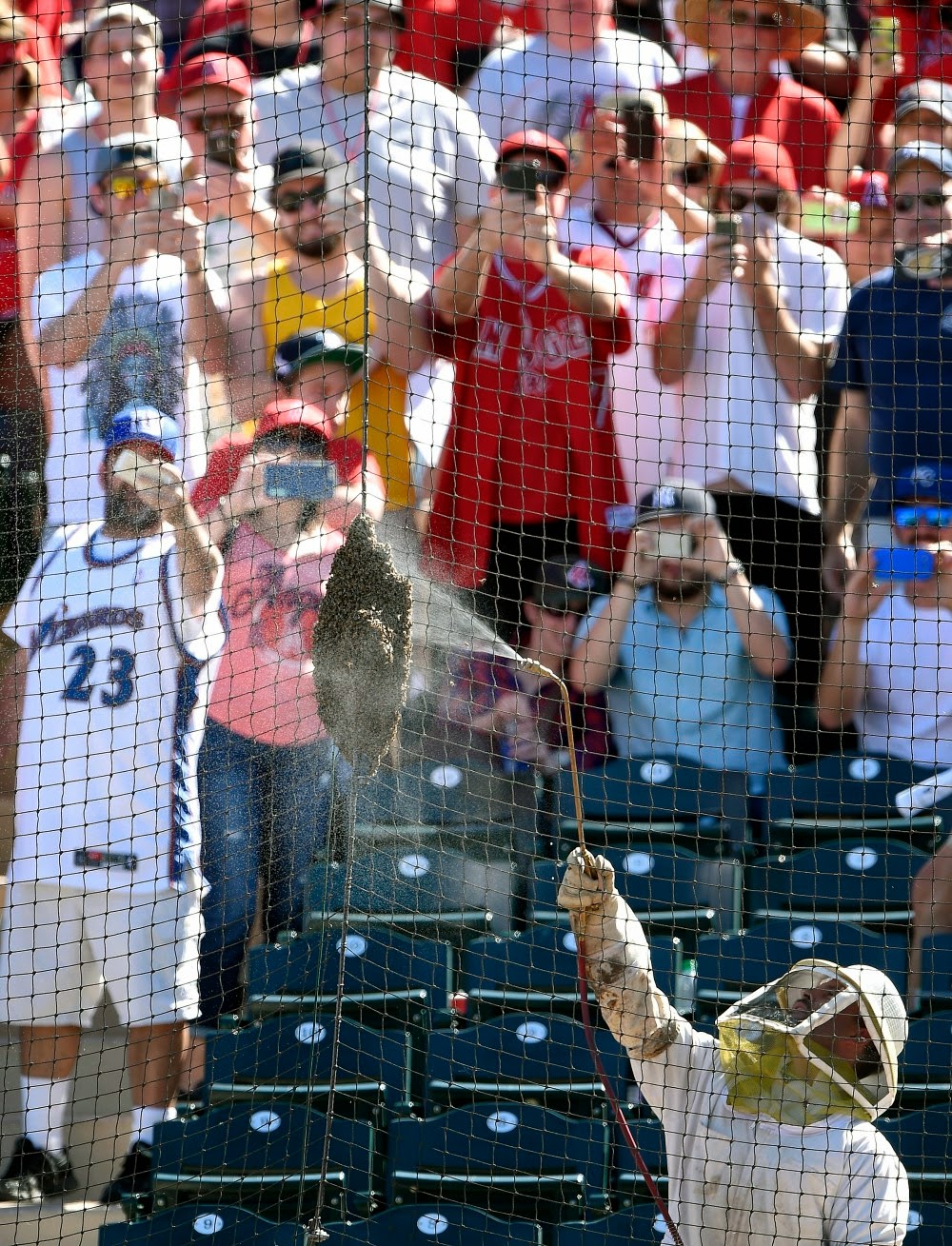
All over the news this weekend was a  story about a honey bee swarm during baseball spring training.

Notice they bring in a bee keeper to save and relocate  the honey bees.  He is spraying the bees with a sugar water mix to keep the honey bees calm.


Check out the link on USA Today

Spring Training Honey Bee Swarm

Planting a Future

Great article and video on the monarch butterfly from CBS Sunday Morning.

Check out the link below

CBS News


Thursday, March 5, 2015

Double Jar Feeder


The picture above is our double jar feeder that we made. This feeder will be filled with a 50/50 mix of water and sugar for the bees to eat when they first arrive in the hive. The reason for the feeder is so the bees get acclimated to the new hive and queen.  Once the bees are comfortable in the hive the jar will be removed from the top box and the bees will roam for  their own for food.

Warre Honey Bee Hive


This is our First Warre Honey Bee hive. The Warre hive is known as the peoples hive for its easy upkeep and happy honey bees.  Happy bees make good honey!

Pinery Pollinators

Image result for honey bee logo
                          Pinery Pollinators
                                                               Pinery Honey Bee/Butterfly Habitat, Tread Lightly
                                                                   www.pinerygcm@blogspot.com 


Come follow our adventure into the world of pollinators. This year we are creating new honey bee and butterfly habitats in the native areas on the golf course.  


Thursday, February 27, 2014

Painted Bunkers?


What up with the painted bunkers? Well this winter we are doing some research with turf protectants on our bunker edges/noses. Throughout the winter even with timely snows and winter watering our southern exposed bunker faces desiccate. This winter we tried something new.  In late November we applied our first of a monthly application of  Turf Screen tank mixed with a anti-transparent on our bunker surrounds. The Turf Screen product is basically a sun screen for turf. With our higher than normal solar radiation  and our  higher altitude coupled with  dry winter air  the Turf Screen should limit the desiccation. The Turf Screen coupled with the anti-transparents,  wetting agents and hand watering  should limit our damage to our southern exposed bunkers.

Friday, October 4, 2013

First Snow !


Today we received our first snow in Parker Colorado!  The forecast calls for snow all day and clearing tonight with a hard freeze and lows in the mid 20's


Thursday, October 3, 2013

Sunrise Temperature Drop

Why, just before sunrise, does the temperature seem to drop?

Just before sunset  and continuing throughout the evening the atmosphere near the Earth's surface starts to cool this  is called radiational cooling. Not until sunrise is when the sun starts heating up the atmosphere, but this is when you actually see the coldest temperatures of the night.  Now  since cold air is heavier than warm air this cold air settles to lower elevations. Then when you add in colder temperatures we can actual have our worst frost slightly after sunrise.

This occurred this morning at  The Pinery since we sit low in the Cherry Creek Valley. We had a hard frost on the lower elevations of the course where the upper elevations had no frost. 

As you can see in this mornings weather report the lowest temperature occurred just after sunrise at 7am 34.4 degrees. 


So just because you didn't  have frost at your home doesn't  mean we wont have frost at the course.  Always check in with the pro shop in the spring and fall for any frost delays.


Thursday, September 19, 2013

Duckweed Bloom

A few weeks ago we had a duckweed bloom in two of our lakes literally overnight?
Of course this was just before labor day.  Fortunately we had some aquatic herbicide Cutter in the chemical storage room. Cutter went down at 1 lb/ per surface acre tank mixed with a surfacent at 100 oz/ acre. The products were sprayed with a spray gun (large droplet size to prevent drifting) covering the entire lake surface.  The next day there was no change and I was a bit upset, but on the third day the duckweed was 1/2 gone and the fourth day so long duckweed!

Below are some before and after pictures. 

August 29th


 September 2nd  Labor day

Tuesday, September 17, 2013

1000 Year Storm?

The latest weather that passed through Colorado over the last seven days gave way to a 1 in 1000 weather event. Which actually means that there is a .1% chance of a storm event like that happening yearly, so its very rare.  This type of storm event is actually  called Return Period  Event.  This does not mean that a 1000 year storm happens regularly every 1000 years. It means the probability of a 1000 year storm has a .1% chance of happening yearly.  These storm events are calculated by  NOAA with historical records and statistical models. Most weather records only go back to the 1870's. So a statistical model or unobserved event is used to predict the severity of that event so NOAA can  label such large historic storms.


Below is a link from NOAA on the 7 day rain totals.
http://www.crh.noaa.gov/bou/?n=preciptotals_multiday

Monday, August 19, 2013

GET-R-DONE


- Tees, collars, approaches done
- Target greens done
- Driving range landing area done
- Driving range divots done
- Driving range swept and mowed
- Bunkers raked 
- Greens rolled
- Fairways done
- Cups cut
- Course set up done
- Club grounds mowed
- 11:30 am 18 hole shotgun 
 
GET-R-DONE with 10 Team Members! 

PRICELESS!